

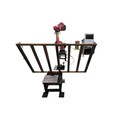
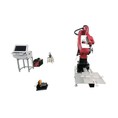
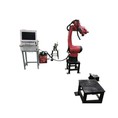
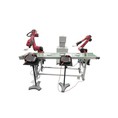
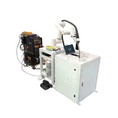
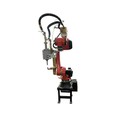
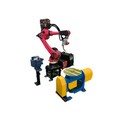
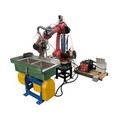
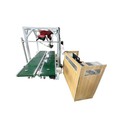
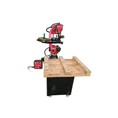
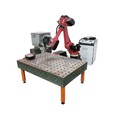
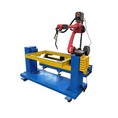
The 1970s saw the advent of practical applications driven by advancements in various technologies, giving rise to robots such as the PUMA series and SCARA robots. Subsequent periods included downturns and recoveries, with global sales growing from 2014 to 2018, and projected to increase by an average of 14% annually from 2019 to 2021. Development varied across countries: the US led in performance and intelligent technology, Japan later became a "robot kingdom," Germany benefited from the growth driven by "Industry 4.0," and China developed its industry through stages of theoretical research and prototype development.
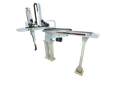
Regarding definition, due to technological advancements, the definition of industrial robots is not yet definitively established, but they possess four significant characteristics: specific mechanical structure, versatility, varying degrees of intelligence, and independence. Classification methods are diverse: based on coordinate characteristics, they can be categorized into Cartesian coordinates, cylindrical coordinates, etc.; based on control methods, they can be divided into non-servo control and servo control; they can also be classified by topology, level of intelligence, drive type, and task, with each category having its own characteristics and applicable scenarios.
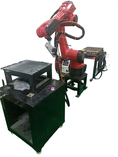
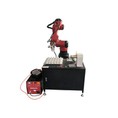
In terms of basic components, an industrial robot consists of three parts: the robot body (manipulator, including the robotic arm, drive and transmission devices, and sensors), the controller and control system, and the teach pendant. Key parameters include degrees of freedom (indicating flexibility, typically 3-6), positioning accuracy and repeatability (measuring positional accuracy), resolution (minimum joint movement distance or rotation angle), working range (set of reachable points at the end effector), maximum speed (affecting efficiency), and load capacity (the maximum mass it can withstand during operation).
Finally, it is mentioned that industrial robots are widely used in many high-tech industries, and future development trends focus on four aspects: intelligentization (improving detection and judgment functions), collaborative control (optimizing human-machine and multi-device integration), standardization and modularization (reducing costs and improving efficiency), and new mechanical configurations (adapting to complex operations).