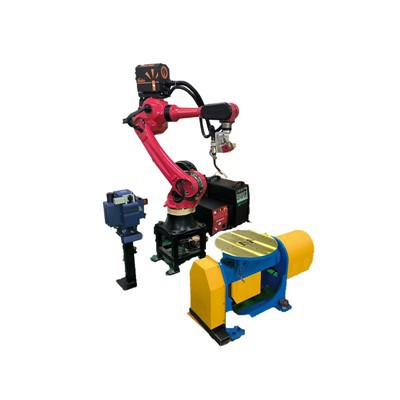

The Borunstech Multi-Product Robotic Welding System is an integrated automation cell engineered for manufacturers processing high-mix, variable-geometry metal components. By combining modular servo-driven positioners, high-payload 6-axis articulated robots, and adaptive seam-tracking sensors, the system executes continuous and interrupted welding across distinct part variants within a single footprint.
Key Features
Adaptive Laser Seam Tracking: Real-time joint tracking sensors compensate for thermal distortion and variable gap tolerances up to 5mm prior to arc ignition.
Modular Multi-Station Positioners: Dual-station 180° servo-driven turntables isolate loading zones from welding zones, achieving 100% arc-on time through simultaneous loading and welding.
Offline Programming & Simulation Suite: Integrates with standard CAD/CAM environments to generate collision-free robot tool paths and calculate accurate cycle times prior to deployment.
Closed-Loop Weld Parameter Monitoring: Digital welding power sources log actual voltage, current, and wire feed speed per weld seam in real-time, exporting data via OPC UA for traceability.
Technical Specifications
|
Technical Parameter |
Specification Range / Standard |
|
Robot Payload Capacity |
6 kg to 210 kg (Configurable per application load and reach requirements) |
|
Positioner Payload |
500 kg to 3,000 kg per station (Dual-axis L-type or headstock-tailstock) |
|
Welding Process Compatibility |
GMAW (MIG/MAG), GTAW (TIG), Pulse Welding, Laser-Hybrid |
|
Power Source Output |
350A – 500A Digital Inverter (Fronius, Miller, or Lincoln Electric integration options) |
|
Positional Repeatability |
plus/minus 0.05 mm to plus/minus 0.08 mm |
|
Control Architecture |
Industrial Robot Controller + PLC (Siemens S7-1200/1500 or Allen-Bradley CompactLogix) |
|
Safety Interlocks |
Category 4, Performance Level e (PLE) light curtains, safety interlock switches, and physical light partitions |
|
Utilities Required |
380V/480V AC (3-phase, 50/60Hz), Compressed Air (0.6 - 0.8 MPa), Shielding Gas (Ar/CO2 mix) |
Applications
Commercial Vehicle Subframes: Multi-axis welding of truck chassis crossmembers, suspension arms, and trailer hitches fabricated from high-strength structural steel.
Agricultural Equipment Enclosures: Automated joining of thick-plate hydraulic reservoirs, harvester housings, and protective cab frames requiring deep penetration and multi-pass fills.
Industrial HVAC & Pressure Vessels: Seam welding of cylindrical stainless steel and carbon steel tanks where internal root pass integrity and pressure-tight joints are mandatory.
Material Handling Pallets & Racks: High-speed repetitive fillet welding of tubular structural steel skids subject to high mechanical load stress.
Welding System
The structural core of the cell relies on heavy-wall structural steel tubing (150 mm x 150 mm x 8 mm minimum) precision-milled on CNC gantry mills to establish a rigid datum reference. The base frame undergoes stress-relieving annealing prior to machining to prevent thermal warpage under continuous robot dynamic loads.
Robot Arm: IP67-rated wrist protection shielding against weld spatter and grinding dust, featuring internal cabling routed through hollow-wrist configurations to eliminate snag hazards.
Torch Cleaning Station: Automated pneumatic reamer equipped with anti-spatter fluid injection clears nozzle buildup every 30 weld cycles, maintaining gas shielding stability.
Wire Feed Management: Roof-mounted or pedestal-mounted dual-drive wire feeders with push-pull configurations prevent bird-nesting over extended 5-meter torch packages.
System Layout & Operational Footprint
Standard Cell Dimensions: Modular perimeter layout requiring an estimated floor space of 4,500 mm x 3,500 mm x 2,800 mm (variable depending on robot reach and positioner swing diameter).
Material Inflow / Outflow Ergonomics: Designed for dual-access loading via forklift, overhead crane, or automated guided vehicles (AGVs), keeping operator safety zones physically separated from dynamic robot collision envelopes.
Perimeter Safety Fencing: Heavy-gauge welded wire mesh panels integrated with dual-channel safety gate interlocks and emergency stop muting zones for safe part loading.
Customization Options
Fixture Interchangeability: Custom hydraulic or pneumatic clamping nests designed to match specific customer part families, utilizing hard-anodized locating pins and quick-disconnect pneumatic fittings.
Vision Inspection Integration: Post-weld 2D/3D optical profile sensors mounted on secondary robot axes or overhead frames to check bead width, undercut, and porosity before unloading.
Robotic Rail Crawlers: 7th-axis floor tracks ranging from 2 meters to 15 meters in length to expand robot working envelopes for extra-long structural profiles.
Software Protocols: Custom fieldbus mapping for direct integration into existing plant MES or SCADA networks via Profibus, Modbus TCP, or Ethernet/IP.
Manufacturing & Quality Control
Machining Precision: All robot mounting pads and positioner base plates are machined on large-scale CNC floor borers to maintain parallelism within 0.03 mm over a 2-meter span.
Weldment Verification: Internal structural frames undergo 100% magnetic particle inspection (MPI) on critical load-bearing joints prior to final assembly.
Factory Acceptance Testing (FAT): Each system undergoes a 72-hour continuous dry-run test followed by actual sample welding using customer-supplied raw materials and wire to verify cycle times and joint shear strength before shipment.
Electrical Compliance: Control panels are wired according to NFPA 79 or IEC 60204-1 standards, utilizing wire-labeled terminal blocks, designated earthing busses, and industrial-grade disconnect switches.
ROI & Production Efficiency Metrics
Arc-On Time Optimization: Elevates standard manual welding arc-on time from 35% up to 85% through dual-station time-shared positioner rotation.
Changeover Time Reduction: Cuts fixture exchange downtime from 45 minutes (traditional bolted hard-tooling) down to under 5 minutes using zero-point pneumatic clamping sub-plates.
Scrap Rate Minimization: Adaptive laser tracking and closed-loop parameter logging reduce weld rework and scrap rates by up to 60% on variable fit-up assemblies.
Industry 4.0 & Data Integration
OT/IT Network Security: Secure industrial Ethernet architecture supporting segregated plant networks, preventing unauthorized external access while maintaining local OPC UA telemetry.
Production Data Logging: Automatically records weld identifiers, timestamps, actual amperage/voltage curves, and operator IDs per part serial number for database archiving.
Predictive Maintenance Diagnostics: Real-time motor torque monitoring and gearbox thermal tracking alert maintenance teams to wear anomalies before unexpected line stoppages occur.
Lifecycle Support & Maintenance Assurance
Remote Diagnostics Gateway: Secure VPN router integrated into the primary electrical enclosure allowing Borunstech engineers to access PLC logic and robot error logs for remote troubleshooting within 2 hours.
Consumable Availability: Standard wear items-contact tips, gas nozzles, swan necks, and torch liners-are maintained in regional distribution inventories for dispatch within 24 hours.
Preventative Maintenance Protocols: Supplied with documented service intervals specifying gearbox oil replacements, battery backup replacements, and backlash calibration checks at 5,000 and 10,000 operational hours.
On-Site Commissioning: Includes a 10-day commissioning package covering mechanical alignment, safety circuit validation, robot path tuning, and operator/maintenance training on site.
FAQ
Q: How long does a typical part changeover take on this multi-product system?
A: Physical tooling swaps using quick-disconnect pneumatic sub-plates take 3 to 5 minutes. Selecting the corresponding welding program from the HMI screen takes under 30 seconds, allowing immediate production resumption without recalibrating base frames.
Q: Can the system accommodate parts supplied with inconsistent fit-up gaps?
A: Yes. The integrated laser seam-tracking sensor scans the joint geometry immediately prior to the weld pass, dynamically adjusting the robot path and adaptive welding parameters in real time to bridge root openings up to 5mm.
Q: What electrical and gas utilities must be present on our shop floor prior to installation?
A: The system requires a 380V or 480V 3-phase power supply (minimum 63A breaker), a compressed air drop delivering 0.6 to 0.8 MPa at 300 L/min, and a regulated shielding gas supply (Argon/CO2 mixture) piped to the cell perimeter.
Q: How are collision events handled to prevent robot or torch damage?
A: The torch is mounted on a mechanical or pneumatic collision sensor. Upon impact, the sensor immediately cuts the safety circuit, halting robot motion within milliseconds to prevent damage to the torch assembly and fixture tooling.
Hot Tags: multi-product robotic welding system, China multi-product robotic welding system manufacturers, suppliers, factory, 20kg Heavy-Duty Welding Robot, automated welding fabrication cell, automated welding line integration, Heavy Duty MIG Welding Workstation, robotic welding system integration line, welding robot material handling system