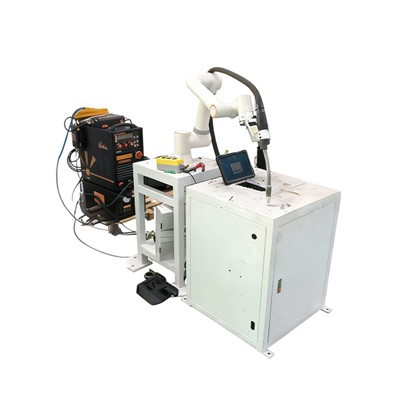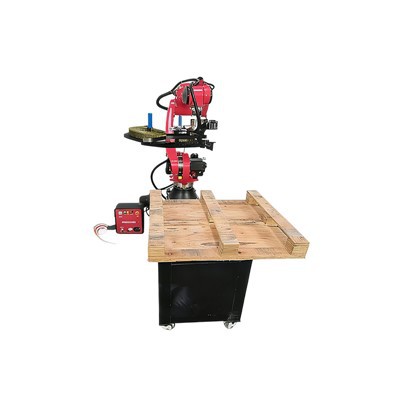

The BR-RA Series integrates a 6-axis industrial articulated robot with a synchronized external rotary axis (single-axis or dual-axis positioner). This configuration establishes coordinated multi-axis motion, maintaining an optimal spatial torch angle while the workpiece rotates continuously or indexes to precise angles.
Engineered for high-mix, medium-to-high-volume metal fabrication, the system eliminates manual handling bottlenecks during circumferential and multi-plane welding. The mechanical interface between the robot controller and the servo-driven positioner ensures interpolated motion, preventing start-stop weld defects common in decoupled setups.
Key Features
Synchronized Kinematic Control: The robot arm and rotary positioner operate under a unified multi-axis controller, enabling true interpolated motion for seamless circular and helical welds.
Rigid Positioner Mechanics: The rotary axis utilizes a heavy-duty harmonic reducer and crossed roller bearings, minimizing backlash below 0.1 arcmin under eccentric loading.
Integrated Pneumatic Tailstock Support: Optional pneumatic or hydraulic tailstocks clamp long workpieces securely, preventing axial deflection and thermal warping during high-heat MIG/TIG processes.
Hollow-Shaft Pass-Through: The rotary axis features an internal through-hole structure that routes torch utility lines, shielding gas hoses, and pneumatic lines internally, preventing cable twisting and entanglement during endless rotation.
Technical Specifications
|
Specification Item |
Parameter Data |
|
Robot Arm Payload |
6 kg / 10 kg / 20 kg options |
|
Robot Reach |
1,410 mm – 2,010 mm |
|
Positioner Payload Capacity |
300 kg / 500 kg / 1,000 kg |
|
Rotary Axis Torque |
450 Nm – 1,800 Nm |
|
Positioning Repeatability |
Robot: +/-0.03 mm |
|
Degrees of Freedom |
6 (Robot) + 1 or 2 (External Positioner) |
|
Compatible Power Sources |
Digital MIG/MAG, TIG, Laser-MIG hybrid (Fronius, Lincoln Electric, Miller interfaces) |
|
Operating Voltage |
380V / 440V, 3-Phase, 50/60 Hz |
|
Enclosure Protection |
IP54 (Arm) / IP65 (Motors and Drives) |
Applications
Automotive Exhaust & Drivetrain: Continuous circular welding of catalytic converters, driveshaft tubes, and suspension links requiring uniform penetration.
Hydraulic Cylinders & Valves: High-deposition fillet and groove welding on thick-walled steel cylinders, end caps, and port fittings.
Industrial Furniture & Fitness Equipment: High-speed repetitive welding of tubular steel frames with complex intersecting joints.
Pressure Vessels & Tanks: Seam welding of small-to-medium pressure vessels, pipe flanges, and cylindrical enclosures.
Welding System Architecture
The cell comprises five integrated industrial subsystems:
Manipulator Arm: Cast-aluminum alloy links driven by absolute encoder AC servo motors, requiring no battery backup for home position retention.
External Positioner: Floor-mounted L-type or headstock-tailstock units driven by high-torque AC servo motors with absolute feedback.
Welding Package: Industrial digital inverter power source, water-cooled torch, 4-roll wire feeder, and auto-cleaning torch station with anti-spatter fluid spray.
Control Cabinet: Dual-CPU industrial controller running real-time bus communication (EtherCAT/CANopen) paired with a teach pendant featuring a 10.1-inch touch screen.
Safety Enclosure: Light curtains, pneumatic interlock safety doors, arc-filtering viewing windows, and fume extraction duct interfaces compliant with ISO 10218-1.
Programming & Software Integration
Offline Programming (OLP): Controller architecture supports standard post-processors compatible with major simulation platforms (e.g., Delfoi, SprutCAM, RoboDK), allowing path generation directly from 3D CAD models.
Coordinated Calibration Wizard: Automated routines calculate the relative position and rotational center of the external positioner, reducing multi-axis setup time.
Factory Network Integration: Native support for standard industrial protocols-including Profinet, Ethernet/IP, and Modbus TCP-enables real-time data exchange with cell-level PLCs and plant MES networks.
ROI & Productivity Metrics
Arc-On Time Optimization: Eliminates manual workpiece positioning delays, driving arc-on time utilization from typical manual levels (30%) up to 75% to 85% in continuous multi-shift operations.
First-Pass Yield Improvement: Synchronized rotary motion maintains optimal gravity-assisted torch angles, reducing weld defect rates, porosity, and post-weld rework by over 40%.
Capital Payback Estimate: Based on standard two-shift utilization in medium-volume job shops, total system investment typically achieves financial payback within 12 to 18 months via reduced labor overhead and scrapped parts.
Customization Options
Positioner Layouts: Horizontal single-axis rotation, L-frame tilting positioners, or dual-station headstock-tailstock setups for pendulum loading.
Collision Protection: Mechanical or electronic collision-detection breakout units that halt execution instantly upon obstruction.
Seam Tracking: Laser vision or tactile arc-sensor modules compensating for thermal distortion and part variance in real-time.
Tooling Plates: Precision-machined sub-plates equipped with pneumatic quick-change pin locators tailored to specific part geometries.
Manufacturing & Quality Control
Structural Machining: Robot base plates and positioner frames are welded from structural steel and annealed in a pit-type gas furnace at 600 deg C to eliminate residual internal stresses prior to precision CNC boring.
Gearbox Calibration: Harmonic reducers and planetary gearboxes undergo backlash testing on optical-encoder test benches; units exceeding the 0.1 arcmin backlash tolerance are rejected.
Geometric Accuracy Inspection: Laser trackers and ball-bar testing protocols verify ISO 9283 trajectory accuracy and multi-axis interpolation precision prior to crating.
Burn-In Testing: Every integrated cell runs a 48-hour continuous dry-run endurance test and a 2-hour live welding test using reference test coupons.
Lifecycle Support & Maintenance Assurance
Spare Parts Availability: Critical wear items (drive belts, contact tips, torch liners, servo drives) are stocked in regional distribution hubs for 48-hour dispatch.
Remote Diagnostic Access: Built-in VPN router enables secure remote PLC and robot controller debugging by application engineers.
Preventive Maintenance Schedule: Detailed lubrication intervals, filter replacement guidelines, and encoder battery life metrics provided in the technical operations manual.
On-Site Commissioning: Field service engineers available for mechanical leveling, electrical tie-in, Tool Center Point (TCP) calibration, and operator training.
FAQ
Q: How does the controller synchronize the robot arm and the rotary axis?
A: The system uses a unified multi-axis motion controller running a single interpolation algorithm. The rotary axis is configured as an external axis, allowing the robot's Cartesian path to be calculated relative to the rotating workpiece coordinate system.
Q: What is the maximum eccentricity load the standard rotary positioner can handle?
A: Standard positioners are rated for specific off-center load moments up to 1,800 Nm depending on the model capacity. Exceeding this requires counterbalancing or upgrading to a higher torque model.
Q: Can this cell integrate with our existing ERP or MES factory network?
A: Yes. The control cabinet supports standard industrial communication protocols including Profinet, Ethernet/IP, and Modbus TCP for production data logging.
Q: What utilities are required on the shop floor for installation?
A: 3-phase industrial power (380V/440V), compressed air supply (0.6 to 0.8 MPa, dry and filtered), shielding gas supply (Argon/CO2 mixtures), and external ventilation ducting.
Hot Tags: welding robot with external rotary axis, China welding robot with external rotary axis manufacturers, suppliers, factory, Automated Welding Robots, automatic pneumatic welding robot, cobot laser welding, Long-Reach Dual-Station Welding Workstation, Spot Welding Robots, welding robot industrial production cell