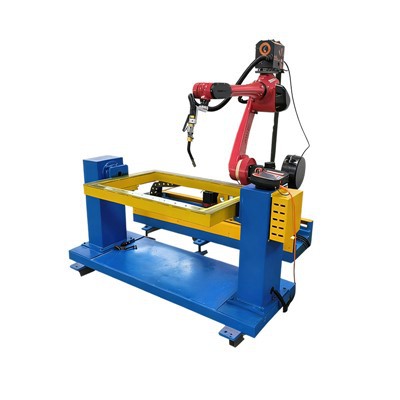

The Welding Robot with Overhead Linear Axis integrates a 6-axis articulated welding robot onto an overhead-mounted external linear track (7th/8th axis) in compliance with ISO 10218-1 and CE directives. Suspending the mechanism above the workspace removes floor obstacles, prevents spatter contamination on rails, and extends the operational envelope for workpieces up to 24 meters, such as structural beams, vehicle chassis, and pressure vessels.
Key Features
Overhead Gantry Configuration: Suspends the linear axis above the work zone to eliminate floor-level obstructions, protect rails from spatter accumulation, and preserve floor space.
Multi-Axis Kinematic Synchronization: Interpolates motion across the 6-axis arm and external linear axes simultaneously to maintain uniform welding speed and torch angle over extended seams.
Heavy-Duty Linear Track Assembly: Built with induction-hardened alloy steel guide rails and preloaded recirculating roller bearing blocks, delivering linear repeatability within +/- 0.05 mm over multi-meter travel.
Integrated Cable Management: Articulated energy chains route welding power cables, shielding gas lines, and control signals overhead to prevent binding, torsion fatigue, and burn-through.
Technical Specifications
|
Technical Parameter |
Specification Value |
|
Available Travel Length (X-Axis) |
3,000 mm – 24,000 mm (Modular increments) |
|
Linear Axis Repeatability |
+/- 0.05 mm |
|
Maximum Traverse Speed |
Up to 1.5 m/s |
|
Compatible Robot Payloads |
6 kg to 210 kg arm capacities |
|
Welding Power Source Integration |
MIG/MAG, TIG, Plasma (Digital inverter-based, 350A – 500A, AWS D1.1 compliant) |
|
Control System |
Multi-axis CNC/Robot controller supporting fieldbus protocols (Profinet, Ethernet/IP, EtherCAT) |
|
Input Power Supply |
3-Phase AC 380V/480V +/- 10%, 50/60 Hz |
|
Operating Ambient Temperature |
0°C to 45°C |
Applications
Construction Machinery: Continuous welding of long excavator booms, crane arms, and bulldozer chassis requiring deep penetration and multi-pass precision.
Commercial Vehicles: Fabrication of truck chassis, trailer side rails, and bus frames where extended reach reduces fixture repositioning.
Pressure Vessels & Tanks: Circumferential and longitudinal seam welding for large cylindrical containers, boilers, and industrial silos.
Structural Steel: Automated welding of H-beams, box columns, and architectural trusses under high duty cycles.
Welding System Components
Robot Manipulator: 6-axis articulated arm featuring hollow-wrist architecture to eliminate external torch cable snagging.
Welding Package: Water/air-cooled torch, 4-roll digital wire feeder, and multi-process inverter power source with waveform control for low-spatter short-circuit and pulse welding.
Seam Tracking & Sensing: Optional laser vision sensors mounted ahead of the torch to compensate for thermal distortion and joint fit-up gaps in real time.
Safety Module: Perimeter light curtains, safety PLC, pneumatic safety gates, and dual-channel emergency stop circuits compliant with ISO 10218-1 and ISO 13849-1 (Category 3, PL d) standards.
Customization Options
Axis Expansion: Addition of an 8th axis, such as a motorized workpiece positioner synchronized with the gantry, or dual robots on a single overhead rail.
Reach & Payload Matching: Selection of specific robot arm reaches (1,400 mm to 3,100 mm) paired with linear rail load ratings.
Environmental Hardening: Bellows covers, heat-resistant shielding, or stainless steel enclosures for high-temperature or dusty environments.
Software Integration: Proprietary PLC logic integration, custom HMI layouts, and offline programming post-processors.
System Architecture & Integration Workflow
Kinematic & Layout Simulation: Digital twin software (ROBCAD/RobotStudio) maps the overhead travel envelope against part geometry and plant ceiling height to identify collision zones before assembly.
Electrical Handshake: Hardwires safety interlocks and configures fieldbus communication (Profinet/EtherCAT) to link the gantry PLC with upstream/downstream conveyors, part clamps, and master SCADA systems.
Pre-Shipment Testing: Assembles the complete system-including the robot, linear axis, power source, and torch cleaner-for a 72-hour dry run and test-weld coupon validation.
Site Calibration: On-site laser tracker calibration of linear axis parallelism and Tool Center Point (TCP) verification conducted by field service engineers prior to sign-off.
Manufacturing & Quality Control
Machining: Gantry base frames and linear rail mounting surfaces are milled on large-scale CNC gantry milling centers in temperature-controlled environments to eliminate thermal warping.
Heat Treatment: Welded structural components undergo stress-relieving annealing at 600°C–650°C to prevent residual stress distortion during long-term operation.
Metrological Inspection: Linear rail straightness, parallelism, and pitch error are verified using laser interferometers and electronic level sensors before assembly.
Factory Acceptance Testing (FAT): Each system undergoes a 72-hour continuous dry-run burn-in test and load verification cycle, generating an individual calibration and accuracy test report.
Lifecycle Support & Maintenance Assurance
Commissioning: On-site deployment supervised by certified automation engineers, covering mechanical leveling, electrical grounding, robot calibration, and initial parameter tuning.
Spare Parts Availability: Critical wear items (drive belts, contact tips, torch liners, roller bearings, servo amplifiers) stocked for 48-hour dispatch.
Remote Diagnostics: Secure VPN gateway module integrated into the control cabinet for real-time remote troubleshooting, firmware updates, and error-code analysis.
Maintenance Schedules: Structured service intervals provided with clear lubrication charts (specifying ISO VG 68 slide-way oils and high-temperature lithium greases) and belt tension verification procedures.
FAQ
Q: How does the overhead linear axis maintain accuracy over a 12-meter span?
A: The track foundation utilizes precision-machined structural steel profiles anchored to concrete or gantry pillars. The rail uses induction-hardened steel with preloaded linear bearing blocks that eliminate play, while closed-loop optical encoders on the servo motor provide absolute feedback to correct minor thermal expansions.
Q: Can the system be integrated into an existing factory PLC network?
A: Yes. The control cabinet supports standard industrial fieldbus communication protocols including Profinet, Ethernet/IP, and DeviceNet for handshake signals with existing production lines and master PLCs.
Q: What is the maximum payload capacity supported on the overhead track?
A: Standard gantry configurations support robot arm payloads ranging from 6 kg up to 210 kg. Custom structural ratings are available for heavy-duty auxiliary equipment mounted on the carriage.
Q: What routine maintenance is required for the linear axis?
A: Routine maintenance involves weekly lubrication of linear guide blocks via centralized grease fittings, monthly inspection of rack-and-pinion or ball-screw backlash, and quarterly belt tension checks. The overhead layout inherently minimizes debris accumulation compared to floor tracks.
Hot Tags: welding robot with overhead linear axis, China welding robot with overhead linear axis manufacturers, suppliers, factory, 3d robot fiber laser cutting machine, 3d robot laser cutting machine, 6 axis welding robot, robotic welding arm, robotic welding automation, robotic welding fabrication system