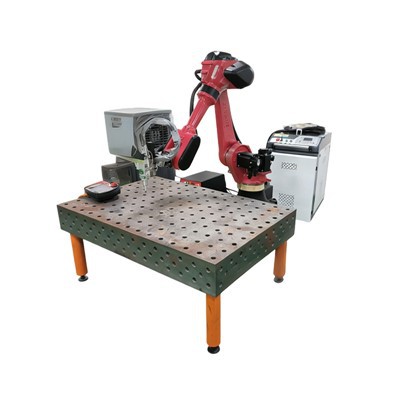

The Borunts Tech Multi-Axis Welding Robot System integrates a 6-axis articulated industrial robot with synchronized external axes-including dual-axis positioners and motorized floor tracks-to execute continuous, multi-angle weld paths in a single setup. Engineered for heavy structural fabrication and high-mix, low-volume production cells, the system coordinates arm motion with part positioning in real time to eliminate manual repositioning and maintain consistent torch angles. Systems comply with CE and ISO industrial standards.
Key Features
Synchronized Multi-Axis Control: Up to 10 axes of coordinated motion managed through a single teach pendant, allowing the welding torch and positioner to move simultaneously without trajectory lag.
Adaptive Seam Tracking: Integrated laser vision sensors compensate for thermal distortion and part tolerance variances during high-heat passes.
Rigid Kinematic Structure: Cast-aluminum and steel-welded arm links optimized via finite element analysis (FEA) to withstand high payload forces and repetitive high-speed deceleration cycles.
Closed-Loop Feedback: High-resolution absolute encoders on every axis eliminate zero-return routines upon startup and maintain positional repeatability.
Technical Specifications
|
Parameter |
Specification |
|
Robot Degrees of Freedom |
6 Axes (Articulated) |
|
Synchronized External Axes |
Up to 4 Additional Axes (Positioner / Slider) |
|
Maximum Payload |
6 kg to 210 kg (Configurable by model) |
|
Reach Radius |
1,400 mm to 3,100 mm |
|
Positioning Repeatability |
+/- 0.05 mm to +/- 0.08 mm |
|
Compatible Welding Power Sources |
Miller, Lincoln Electric, Fronius, OTC (Digital MIG/TIG/Pulse) |
|
Control System |
32-bit Multi-Axis Industrial Controller |
|
Programming Interface |
Teach Pendant (Graphical UI) + Offline Programming Support |
|
Communication Protocols |
Profinet, Ethernet/IP, DeviceNet, Modbus TCP |
|
Operating Environment Temperature |
0 deg C to 45 deg C |
Applications
Construction Machinery: Boom arms, excavator frames, and hydraulic cylinder brackets requiring deep-penetration multi-pass welds.
Automotive Tier-1: Subframe assemblies, suspension links, and exhaust manifolds demanding high cycle speeds.
Pressure Vessels & Tanks: Circumferential and longitudinal seam welding on stainless steel and carbon steel cylindrical bodies.
Railway & Rolling Stock: Bogie frames and structural underframes subjected to strict fatigue-resistance standards.
Welding System
Wire Delivery: Push-pull wire feeder configuration prevents bird-nesting over extended reach distances (> 3 m).
Torch Protection: Mechanical breakaway crash sensor immediately halts robot motion upon physical obstruction, preventing damage to the torch neck and workpiece.
Spatter Control: Digital waveform control regulates droplet detachment, reducing post-weld grinding labor.
Support Equipment: Includes a heavy-duty wire feeder, water-cooled torch cleaner/re-reamer station, and digital inverter power source capable of pulse MIG/MAG welding.
Customization Options
Work Envelope Extension: Floor-mounted linear tracks ranging from 2 meters to 15 meters for large-workpiece processing.
Positioner Variants: L-type positioners, headstock-tailstock turntables, and horizontal/vertical dual-station rotators rated from 500 kg to 5,000 kg capacity.
Seam Sensing Add-ons: Arc-sensor tracking (weaving-based voltage/current feedback) or optical laser seam finders prior to arc initiation.
Enclosure Design: Full laser-safety cell enclosures with pneumatic sliding doors and integrated fume extraction ducts.
Manufacturing & Quality Control
Castings & Machining: Robot bases and arm segments are machined on 5-axis CNC boring mills to ensure geometric alignment tolerances within 0.02 mm.
Gearbox Production: Harmonic drives and RV reducers undergo 72-hour continuous load testing to verify backlash limits under <= 1 arcmin.
Electrical Assembly: Control cabinets wired to IP54 standards with industrial-grade terminal blocks and isolated power distribution.
Lifecycle Support & Maintenance Assurance
Remote Diagnostics: Secure VPN router integrated into the control cabinet for real-time PLC/robot log extraction and firmware updates.
Spare Parts Inventory: Critical mechanical components (reducers, servo motors, teach pendants) stocked locally at regional distribution hubs for 48-hour dispatch.
Preventive Maintenance Guidelines: Scheduled lubrication intervals and consumable replacement checklists provided in the technical operations manual.
Engineering Training: On-site or factory-certified operator training covering teach pendant programming, torch alignment, and basic troubleshooting.
Case Studies & ROI Metrics
Heavy Machinery Boom Welding Cell: A Tier-1 construction equipment manufacturer integrated a dual-station 8-axis welding robot system to fabricate excavator booms.
Result: Arc-on time increased from 35% to 78%, and post-weld grinding labor was reduced by 60%.
Pressure Vessel Longitudinal Seam Cell: Deployed a synchronized roller-bed positioner cell for 12mm stainless steel tanks.
Result: Achieved 100% first-pass X-ray inspection compliance with zero weld porosity defects.
Estimated ROI Timeline: Average capital payback period ranges from 14 to 18 months based on two-shift operations and reduced manual rework costs.
Factory Acceptance Testing (FAT) & Shipping Protocol
Pre-Shipment FAT: Before crating, every system undergoes a 72-hour dry-run and live-weld simulation using client-supplied sample materials at our manufacturing plant. Clients receive a comprehensive FAT report including laser tracker alignment data and electrical safety certificates.
Modular Packaging & Crating: Disassembled into modular sub-units (robot base, control cabinet, positioner decks) and secured inside vacuum-sealed, moisture-proof ISPM 15 compliant wooden crates suitable for global ocean and air freight.
On-Site Commissioning Support: Optional dispatch of Borunts Tech senior automation engineers for on-site mechanical alignment, I/O handshake verification, and initial production run sign-off.
FAQ
Q: What is the minimum batch size required to justify a multi-axis welding robot system?
A: Optimized for high-mix, low-volume production and mass manufacturing. Quick-change tooling fixtures and offline programming software minimize changeover downtime, making batch sizes as low as 20 units economically viable.
Q: Can the system integrate with our existing welding power sources?
A: Yes. The controller features open communication interfaces and standard analog/digital I/O ports capable of integrating with major power source brands including Fronius, Lincoln, and Miller.
Q: How does the system compensate for thermal deformation in thick plates?
A: Laser seam tracking sensors scan the joint immediately ahead of the welding arc, feeding real-time coordinate offsets back to the robot controller to dynamically adjust the torch trajectory.
Q: What utilities are required on the factory floor for installation?
A: A 3-phase 380V/480V power supply, compressed air at 0.6 to 0.8 MPa for pneumatic fixtures, and a shielding gas line (Argon/CO2 mix).
Hot Tags: multi-axis welding robot system, China multi-axis welding robot system manufacturers, suppliers, factory, 3d robot fiber laser cutting machine, arc welding robot, automated welding production system robot, Heavy Duty MIG Welding Workstation, industrial welding automation cell, robotic TIG welding