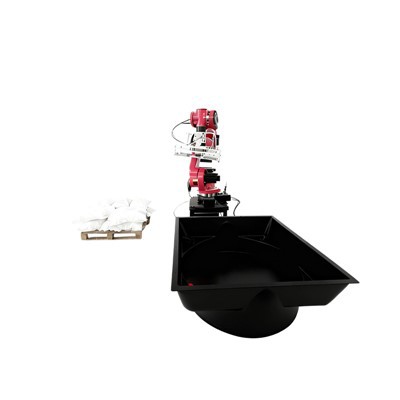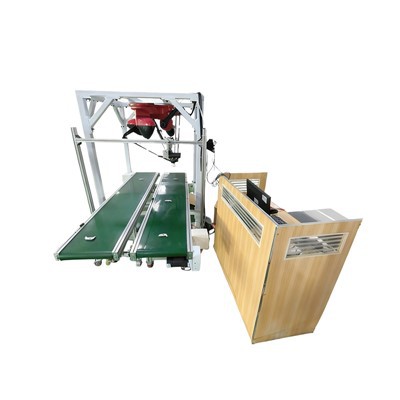

The Boruntestech Flexible Welding Automation System integrates multi-axis mechanical manipulators, programmable motion controllers, and precision adaptive welding power sources into a modular architecture. Built for fabrication environments shifting from high-volume batch production to high-mix, low-volume manufacturing, the system reduces fixture changeover times through software-driven workpiece positioning and adaptive seam tracking.
Key Features
Synchronized Multi-Axis Motion Control: Coordinates up to 6 primary motion axes (gantry, manipulator arm, and rotational positioners) with servo-driven backlash-reduced planetary gearboxes.
Adaptive Laser Seam Tracking: Real-time laser triangulation sensors correct torch trajectory deviations up to plus or minus 15 mm laterally and vertically during active welding passes, compensating for thermal distortion and joint gap variations.
Modular Tooling & Quick-Change Interface: Pneumatic and mechanical clamp receivers enable fixture swapping within 15 minutes, utilizing standardized utility docking plates for shielding gas, cooling water, and power.
Process Parameter Monitoring: Closed-loop logging records arc voltage, current, wire feed speed, and travel speed at 100 Hz, storing batch data for quality traceability.
Technical Specifications
|
Parameter |
Specification Range |
|
Input Power Supply |
380V - 480V AC (plus or minus 10 percent), 3-phase, 50/60 Hz |
|
Compatible Welding Processes |
GMAW, FCAW, GTAW, Plasma |
|
Welding Current Range |
30A - 600A (Dependent on power source configuration) |
|
Rated Duty Cycle |
100 percent at 400A (40 deg C ambient) |
|
Path Repeatability |
plus or minus 0.05 mm (Linear axes), plus or minus 0.03 deg (Rotary axes) |
|
Max Workpiece Load Capacity |
500 kg to 3000 kg (Configurable positioner dependent) |
|
Communication Protocols |
Profinet, Ethernet/IP, Modbus TCP/IP, OPC UA |
|
Operating Environment |
0 deg C to 40 deg C, humidity under 90 percent non-condensing |
Applications
Pressure Vessel & Tank Fabrication: Circumferential and longitudinal seam welding for carbon and stainless steel cylindrical shells ranging from 800 mm to 3500 mm in diameter.
Heavy Machinery Structural Components: Multi-pass fillet and groove welding on thick-section structural booms, chassis frames, and excavator arms utilizing heavy-payload positioners.
Pipe & Tube Spool Manufacturing: Automated orbital and multi-axis joint welding for process piping assemblies in chemical processing and power generation sectors.
Automotive Sub-Assemblies: High-duty-cycle robotic and mechanized welding cells for suspension brackets, truck axle housings, and trailer frames.
Subsystem Architecture
Controller Core: Centralized programmable logic controller linked via EtherCAT bus to absolute encoder servomotors.
Motion Kinematics: Structural gantry frames, vertical manipulator arms, and rotational positioners providing synchronized multi-axis movement.
Power & Delivery: Water-cooled digital inverter power source paired with a 4-roll gear-driven push-pull wire feeder for alloy wires (diameter 0.8 mm to 2.0 mm).
Sensing Module: Motorized cross-slide featuring magnetic breakaway crash protection, laser stripe sensors, and integrated gas lens shielding architecture.
Auxiliary Utilities: Industrial process chillers, on-torch fume extraction hoods, and regulated shielding gas management manifolds.
Customization Options
Envelope Expansion: Gantry span extensions up to 8 meters and rail travel lengths in 2 meter modular increments.
Positioner Integration: Tailstock-headstock setups, L-shaped multi-axis positioners, or dual-station Ferris-wheel turning rigs.
Seam Sensing Variations: Choice of laser stripe sensors for joint tracking or tactile through-arc seam tracking (TAST) for high-deposition thick plate applications.
Fume Extraction Integration: On-torch extraction hoods or overhead canopy ducting interfaces synchronized with arc ignition sequences.
Manufacturing & Quality Control
Mechanical Machining: Structural gantry bases and positioner frames undergo stress-relieving annealing followed by CNC floor-boring machine operations to ensure parallel alignment tolerances within 0.05 mm per meter.
Electrical Assembly: Control cabinets are built in accordance with UL/CE panel wiring standards, utilizing industrial-grade terminal blocks, wire labeling, and isolated power distribution routing.
Factory Acceptance Testing (FAT): Every system undergoes a 72-hour continuous burn-in test under simulated load, measuring axis backlash, positional accuracy via laser interferometry, and thermal stability of drive motors before crating.
Traceability Documentation: Delivered with material mill test certificates for structural steel, component calibration sheets, electrical schematics, and individual servo drive inspection logs.
Safety & Compliance Standards
Electrical & Control Safety: Control enclosures comply with NFPA 79 and CE machinery directives, featuring dual-channel safety PLC architecture, Category 3/4 emergency stop circuits, and hardwired safety interlocks.
Laser Safety Integration: Integrated laser seam tracking modules utilize Class 2 visible red semiconductor lasers, ensuring safe operator alignment without hazard eyewear during standard production runs.
Mechanical Ergonomics & Safeguarding: Perimeter light curtains, safety gate switches, and physical safety fencing interfaces prevent operator access into active motion envelopes during high-speed gantry and positioner transitions.
Arc Radiation & Ventilation Shielding: Auto-darkening welding curtains, weld-spatter enclosure shields, and integrated source-capture fume extraction ports meet OSHA and ISO 15012 standards for air quality control.
Software & Offline Programming
CAD/CAM Path Generation: Direct import capability for STEP, IGES, and Parasolid CAD files, allowing engineering teams to map multi-pass weld paths and torch angles directly from 3D models.
Virtual Simulation Environment: Offline programming software simulates axis kinematics, reach limits, and collision detection zones prior to downloading executable code to the shop floor controller, preventing equipment crashes.
Weld Recipe Optimization: Software algorithms automatically calculate travel speeds, wire feed rates, and heat input values based on joint geometry and plate thickness, minimizing trial-and-error programming.
Version Control & Backup: Cloud-ready or local network database archiving stores verified welding programs, allowing instant reloading of historical recipes when switching production batches.
Proven Track Record & Case Studies
Thick-Wall Pressure Vessel Manufacturer: Deployed a dual-station gantry welding system for 30 mm carbon steel pressure vessels, reducing manual multi-pass fit-up and welding cycle times by 45 percent while eliminating inter-pass grinding defects.
Heavy Construction Equipment Tier-1: Integrated a 6-axis flexible boom system for articulated excavator chassis fabrication, maintaining strict structural weld compliance across high-mix, low-volume production batches.
Industrial Pipe Spool Fabricator: Implemented an automated orbital and linear profiling cell that increased daily throughput from 4 spools to 11 spools with zero reject rates on radiographic weld testing.
Lifecycle Support & Maintenance Assurance
Remote Diagnostics & Support: Integrated router connection allows secure factory engineering access for PLC ladder logic updates, parameter optimization, and error log analysis.
Spare Parts Availability: Critical wear items (contact tips, gas nozzles, wire guide liners, drive rolls, and servo cables) are stocked for immediate dispatch with guaranteed availability for 10 years post-purchase.
On-Site Commissioning: Field service engineers supervise mechanical leveling, electrical tie-in, baseline calibration, and initial production run-offs at the buyer's facility.
Operator Training: Modular training curriculum covering daily maintenance checks, HMI recipe editing, torch consumable replacement, and basic troubleshooting procedures.
FAQ
Q: What is the minimum batch size that makes automated welding economically viable with this system?
A: The modular quick-change fixture interfaces and recipe storage reduce setup downtime to under 20 minutes, making batch sizes as small as 10 to 20 units economically practical compared to dedicated hard automation.
Q: Can the system integrate with existing third-party welding power sources already installed in our facility?
A: Yes. The control architecture supports analog (0-10V) and digital communication interfaces to interface with power sources from major industrial brands.
Q: What is the required utility infrastructure on the shop floor?
A: The system requires a 3-phase 380V-480V electrical drop, a compressed air supply (0.6 - 0.8 MPa) for pneumatic clamping, and an industrial shielding gas line.
Q: How does the system handle material thickness variations across hot-rolled steel plates?
A: The integrated laser vision tracker measures joint root opening and high-low misalignment prior to and during the welding pass, automatically modulating travel speed and weave amplitude to ensure complete root penetration.
Hot Tags: flexible welding automation system, China flexible welding automation system manufacturers, suppliers, factory, Argon Arc Welding Robot, Automated Welding Robots, Collaborative TIG Welding Robot, industrial welding automation cell, Laser Welding Robot, robotic welding structural steel system