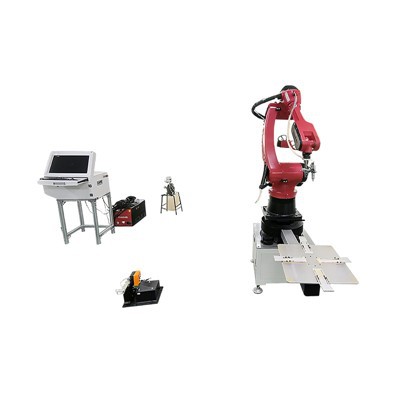

The Chuanglida Intelligent Equipment Quick-Change Robotic Welding System enables automated end-effector swapping for industrial robots in high-duty-cycle cells. Integrating a pneumatic-locking master-tool plate assembly with automated electrical, fluid, and shielding gas pass-through modules, the system allows a single robot to transition between MIG/MAG, TIG, or plasma welding torches and material handling grippers within 0.3 seconds.
Key Features
Zero-Play Mechanical Locking: Dual-acting pneumatic pistons drive hardened steel locking balls into a tapered V-groove, achieving mechanical pre-load and eliminating radial play during high-acceleration robot moves.
Pneumatic Fail-Safe Retention: Internal mechanical springs maintain the clamped state during sudden plant air pressure loss, preventing accidental dropping of heavy welding guns.
High-Density Utility Modules: Modular blocks house high-current welding power pins, servo-gun control lines, compressed air channels, and shielding gas paths in a compact interface.
Integrated Collision Sensing Pass-Through: Dedicated low-latency circuit channels route crash-box signals directly to the robot emergency stop circuit, halting motion within 5 ms of a collision.
Technical Specifications
|
Technical Parameter |
Specification Value |
Test Standard / Condition |
|
Max Payload Capacity |
50 kg to 300 kg (Model dependent: BRT-50 to BRT-300) |
Static & Dynamic Rated Load Test |
|
Repeatability |
plus/minus 0.01 mm |
ISO 9283 (After 1,000,000 cycles) |
|
Actuation Pressure |
0.5 MPa to 0.7 MPa (Clean, dry air per ISO 8573-1) |
Pneumatic Functional Test |
|
Pneumatic Ports |
4 to 8 ports (G1/8 or G1/4, max pressure 1.0 MPa) |
Flow & Pressure Decay Test |
|
Electrical Circuits |
Up to 30 signal pins (2A / 60V) + 2 power pins (50A / 500V) |
Dielectric Withstanding Voltage Test |
|
Shielding Gas Channel |
Integrated face-seal port (0.8 MPa max working pressure) |
Helium Leak Test |
|
Operating Temperature |
0 deg C to +60 deg C |
Thermal Chamber Endurance Test |
Applications
Automotive BIW Welding: Automated switching between resistance spot-welding guns and MIG seam-welding torches on a single multi-axis robot arm.
Heavy Equipment Fabrication: Rapid changing of heavy water-cooled MIG welding torches and slag-hammer utility tools for earthmoving machinery frames.
Multi-Process Robotic Cells: Integration of automated welding followed immediately by pick-and-place part unloading using interchangeable end-effectors.
Aerospace Component Manufacturing: Precision positioning of TIG welding torches requiring strict electrical isolation and stable gas purge lines.
Welding System Integration
Robot Flange Compatibility: Direct bolt-on interface for standard robot wrist configurations conforming to ISO 9409-1 (ISO 50, ISO 63, ISO 80, ISO 100, ISO 125).
Torch Mounting Interface: Standardized adapter plates match robotic torch mounts (such as Binzel, TBi, Tregaskiss) and water-cooling hose layouts.
Signal Integration: Fieldbus-compatible connector modules route sensor feedback, arc-ignition signals, and wire-feeder data directly to the controller without external cable clutter.
Field Wiring & System Architecture
Signal Interlock & Safety Circuitry: The master plate features a dedicated pneumatic proximity switch circuit feeding dual-channel mechanical confirmation signals back to the controller. Robot motion is programmatically interlocked until full locking-pin engagement is verified (0.05 s response threshold).
Fieldbus Protocol Pass-Through: Modular internal PCB options support direct pass-through for industrial fieldbuses (Profinet, EtherCAT, CC-Link IE), preventing signal degradation across the mechanical split interface.
Cable Management Integration: Designed to accommodate standard robotic dress pack brackets and spring-loaded retractors, minimizing cable torsion during multi-axis torch reorientation.
Customization Options
Custom Pass-Through Configurations: Tailored pneumatic port sizing (M5 to G3/8) and specialized electrical pin layouts for servo-driven torch cleaning stations or laser seam trackers.
Specialized Alloy Bodies: Stainless steel (SUS304/SUS316) or titanium-coated variants for corrosive chemical environments or cleanroom-adjacent welding cells.
High-Temperature Shielding: Integrated ceramic heat shields and reflective thermal barriers for direct exposure to high-heat plasma or heavy arc welding operations.
Manufacturing & Quality Control
Machining Precision: Master and tool plates are machined on 5-axis DMG Mori CNC vertical machining centers in a temperature-controlled workshop to maintain critical datum tolerances within plus/minus 0.005 mm.
Material Traceability: All structural aluminum blocks (Al 7075-T6) and alloy steel components (42CrMo) carry mill test certificates (MTC) conforming to EN 10204 3.1.
Surface Hardening: Steel locking pins undergo gas carburizing and induction hardening to achieve a surface hardness of HRC 58-62, verified via Rockwell hardness testing.
Factory Acceptance Testing (FAT): Every unit undergoes a 100,000-cycle endurance test under rated load, combined with pneumatic burst pressure testing at 1.5x working pressure and electrical continuity checks (< 10 mOhm).
Lifecycle Support & Maintenance Assurance
Wear-Part Replacement Kits: Modular locking balls, elastomer O-rings, and spring assemblies are available as standard stock items for scheduled maintenance.
Mean Time Between Failures (MTBF): Rated for >= 2,000,000 full locking/unlocking cycles before major overhaul or pin replacement.
Technical Documentation: Comprehensive maintenance manuals, seal replacement guides, and 3D CAD STEP files are supplied upon project handover.
Warranty Coverage: 24-month or 1,000,000-cycle warranty against manufacturing defects and structural mechanical failure.
FAQ
Q: Which robot brands are compatible with the Chuanglida Intelligent Equipment system?
A: The master plate adopts standard ISO 9409-1 mounting patterns, making it compatible with industrial robots from Fanuc, ABB, KUKA, Yaskawa, Universal Robots, and Staubli. Custom adapter flanges can be manufactured for non-standard robot wrists.
Q: What happens to the tool plate if plant air pressure drops during operation?
A: The internal mechanical spring mechanism maintains the locking state. Plant air pressure is only required to compress springs and actuate the unlocking stroke; an abrupt pressure loss will not release the attached torch.
Q: How are electrical signals protected from welding current interference?
A: Signal pins are physically separated from high-current welding power pins within insulated modular blocks. Gold-plated signal contacts prevent micro-arcing and maintain stable low-resistance communication for bus signals.
Q: What is the recommended maintenance interval for seal replacement?
A: Pneumatic O-rings and dynamic seals should be inspected and serviced every 500,000 cycles or 12 months, depending on workshop duty cycles. Seal replacement kits can be installed on-site using standard hand tools.
Hot Tags: quick-change robotic welding system, China quick-change robotic welding system manufacturers, suppliers, factory, Handheld Welding Robot, industrial welding robot handling cell, Laser Welding Robot, robotic spot welding machine, robotic welding arm, Secondary Welding Robot